Tuesday, March 18, 2014

Bio-Tech Propaganda: “GMO Food is Good for Your Health”, Killing the World by Feeding the World


food
 The British government appears hell bent on ramming the GM biotech sector’s poison done the throats of the British people. Food and Farming Secretary Owen Paterson has been called a puppet of the sector and is either ignorant of or is wholly misrepresenting the efficacy and health impacts of GMOs (1), while Anne Glover, Chief Scientific Advisor of the European Commission, has been accused of presenting lies as facts over the GM issue (2).
Now the British government’s Chief Scientist, Mark Walport, has insisted that EU rules banning the commercial cultivation of GM crops have to be changed to feed the world:
“We take it for granted that because shelves in supermarkets are heaving with food there is no problem. But we have limited agricultural land around the world and in the UK.
Climate disruption and population growth are increasing the pressures on food supply. The challenge is to get more from existing land in a sustainable way, or people will go unfed.”
In a recent letter to PM David Cameron, he said:
“We should have confidence in the scientific evidence which concludes that, when properly controlled, GM products are as safe as their conventional counterparts.”
Genetic scientist Jonathan Jones has weighed in by claiming:
“How anyone could think this is a bad thing boggles the mind. We need to better explain that there is nothing intrinsically wrong with the GM method.”
  Perhaps Paterson, Glover, Walport and Jones would like to turn their minds to a vast body of scientific evidence that serves to make their claims look ridiculous. If Walport places so much faith in scientific evidence, here is some for him to chew on.
  GMOs and glyphosate, which is used in conjunction with many GM crops and in increasing quantities as more GM crops are planted (3,4), are associated with birth defects and infertility (5), autism, Parkinson’s, Alzheimer’s (6), celiac disease and gluten intolerance (7), Morgollons disease (8) and a wide range of other diseases (9,10).
  In terms of solving hunger, his argument is flawed too: more traditional methods of producing food produce lead to greater results and are genuinely sustainable, unlike chemical-industrial agriculture and GMOs which are clearly not (11,12,13,14,15).
Predictably, however, much of the mounting evidence about the negative impacts of GMOs is dismissed by the GM sector as ‘bad science’ appearing in bogus (yet peer reviewed) publications, whereas the ‘independent’ studies that the sector’s mouthpieces choose to quote are carried out, funded or somehow supported by from the industry itself.
 GMOs and the imperialist mindset
If Paterson et al really want to address hunger, they need look no further than the type of corporate-driven economic plunder being pursued under the guise of neo-liberalism (16) and the associated nature of the global system of food production and distribution (17), which by creating indebtedness and destroying food sovereignty is skewed to benefit rich nations and creates and sustains hunger and food poverty and unnecessary ‘population pressures’ in parts of the world.
Paterson et al may like to take a hard look at the imperialist policies being pursued by rich nations under the banner of ‘globalisation’ or ‘spreading democracy’ via militarism or ‘free’ trade if they or the corporations they are backing are keen to talk about feeding the world and a world of plenty for all. Those policies, whether applied to Ukraine (18), India (19) or imposed on ordinary people in the EU (20) or elsewhere are aimed at concentrating wealth and power in the hands of a corporate global oligarchy. The type of solution they propose for food poverty is the type of solution that springs from an engrained imperialist mindset, however unwitting that mindset may be. We already live in a world of plenty – appropriated from those who are denied it.
As if to underline that fact, many people in Britain are going hungry, one of the richest nations on the planet, not because of a lack of food, but because they are being impoverished as a result of the very policies outlined above (21). It’s a microcosm of what’s happening throughout the world.
 Such people (Walport, Paterson, etc) could spend their time more usefully by lobbying against such policies as opposed to lobbying for the corporations and the US state that fuel this system and which seek to profit from using tampered with food as a weapon to control food producers, food consumers and nation states.
New pro-GM ‘independent’ report
Walport and Jones’s statements came on the back of a report from a government advisory body released last week. It was presented as an ‘independent’ report in a bid to speed up the use of GM food in the UK, regardless of the fact that British people do not want it (22). However, according to the Mail Online (23), all five authors of the report have a vested interest in promoting GM crops. Little surprise then that they call for GM crops to be fast-tracked into Britain.
The academics who authored the report were selected by the Council for Science and Technology, the body that advises the British Prime Minister on science policy issues. According to Sean Poulter and Ben Spencer of the Mail Online, no information was given during the press conference about the report regarding the five scientists, beyond their names and the institutions they work for.
 One is a consultant for Syngenta, which gives his academic department research funding. Syngenta is behind a GA21 GM maize or corn, which could go into farms as early as next spring, making it Britain’s first commercially grown GM crop. Another author works for the Sainsbury Laboratory, which is at the centre of Britain’s GM research. It is part-funded by Lord Sainsbury, who is one of the country’s biggest supporters of the technology. And another author was a founder member of CropGen, which describes its mission as “to make the case for GM crops and foods.”
The study suggested GM crops could save the hungry in the developing world from starvation and create new plants resistant to disease and pests – similar to the usual PR that the GM sector spews out in its glossy brochures. The authors argued that current EU regulation should be re-drawn to allow the UK to go it alone and plant the crops, even if the rest of Europe objects.
 Claire Robinson of GM Watch has said:
“By no stretch of the imagination can these people be described as independent scientists. Their views should be treated with the same scepticism we would apply to any sales pitch.”
 Critics say the timing of the release of the study and a supporting letter from Mark Walport, are highly suspicious. The details were sent to PM David Cameron in November, but Walport and ministers delayed going public until now. Walport claimed that the regulations, which have so far kept commercial GM cultivation out of Britain, are not fit for purpose and need urgent changes.
 Owen Paterson, who is little more than a mouthpiece for the GM sector, is trying to convince the EU to allow Britain to plant GM crops even if other states want a ban. The Mail Online says the publication of the supposedly independent study calling for exactly this policy is expected to prove useful in those negotiations.
Director of GM Freeze, Liz O’Neill, asserts:
“A group of scientists with financial interests in the success of GM wrote a letter to the Prime Minister in November, but waited four months to tell the press about it: just in time for EU discussions about regulation. Something certainly smells a bit fishy.”
Dr Brian John, of the group GM Free Wales, said:
“This extraordinary report, published very conveniently to coincide with Owen Paterson’s attempts within the EU to dismantle GM regulations and to repatriate powers to the UK, is in turns naive, biased, disingenuous, cynical, and downright dangerous. We find it incredible that five senior scientists can have been so dismissive of the work of  scores of independent scientists who have discovered that GM organisms are directly and indirectly harmful to mammals and to  the environment. In the world of science there should be respect for those whose findings are ‘inconvenient.”
The Science Media Centre, which released the report, insisted the authors were independent. A spokesman said:
“They are not employed by government or industry, and each works for different publicly funded universities and research institutes. For better or worse, it’s not unusual any more for universities and institutions to get bits and pieces of funding from government, charities and industry – indeed many can only access public money on condition that they raise a proportion of their funds from commercial or private sources. This does not automatically undermine their independence.”
One of the authors of the report by the, which advises the government, argued that the debate had been skewed by an anti-GM ‘neurosis’ which has slowed progress.
Soil Association chief executive Helen Browning argued:
“It’s really just not good enough for a group of scientists who have a strong interest, it seems, through their funding sources, in persuading a reluctant public to accept the growing of GM crops in the UK, to be the ones who attempt to write the rule book on how that should happen.”
Does Britain or for that matter the world want to hand over its entire food sovereignty to US agribusiness, which wants to control the entire system of food production and distribution (24)? Recent events in India indicate how GM sector puppets in high political office are narrowing our choice (25). People are already dying as a result of the chemicals being inserted into and sprayed onto their food. GMOs offer more of the same and also provide the opportunity for the US to hold virtually every country on the planet to ransom once its corporations own all food, from lab to seed to table.
Notes
1) http://www.independent.co.uk/news/uk/politics/tory-mp-says-progm-environment-secretary-owen-paterson-is-industry-puppet-8686133.html
 2) http://gmwatch.eu/index.php/news/archive/2014/15308-eu-chief-science-adviser-s-gmo-safety-claims-are-a-lie
3) http://www.globalresearch.ca/genetic-engineering-and-corporate-agribusiness-gmos-and-the-impacts-of-glyphosate-herbicide/5337096
4) http://www.organic-center.org/reportfiles/13Years20091126_FullReport.pdf
5) http://www.motherjones.com/tom-philpott/2013/10/argentina-cancer-cluster-pesticide
6) http://www.mdpi.com/1099-4300/15/4/1416
7) http://nhrighttoknowgmo.org/BreakingNews/Glyphosate_II_Samsel-Seneff.pdf
8) http://www.globalresearch.ca/gmo-and-morgellons-disease/8464
9) http://www.responsibletechnology.org/health-risks
10) http://covvha.net/glyphosate-gmo-chemicals-101-scientific-studies/#.Uww6cuNdWSr
11) http://www.tandfonline.com/doi/full/10.1080/14735903.2013.806408#tabModule
12) http://www.i-sis.org.uk/BtCottonKillsSoilandFarmers.php
13) http://www.fwi.co.uk/articles/06/02/2013/137518/us-farmers-may-stop-planting-gms-after-poor-global-yields.htm
14) http://www.deccanherald.com/content/329309/of-falling-bt-yield-disastrous.html


16) http://www.theguardian.com/commentisfree/2013/nov/01/how-economic-growth-has-become-anti-life

17) http://news.bbc.co.uk/hi/english/static/events/reith_2000/lecture5.stm

18) http://www.globalresearch.ca/what-is-the-endgame-the-break-up-of-ukraine/5371710


20) http://www.countercurrents.org/todhunter200613.htm

21) http://www.express.co.uk/news/retirement/22911/Pensioners-go-hungry-to-make-ends-meet


America’s Advancing Empire: Putsch, Pillage and Duplicity


petras
The Obama regime, in coordination with its allies and proxies, has re-launched a virulent world-wide campaign to destroy independent governments, encircle and ultimately, undermine global competitors, and establish a new US – EU centered world order.
We will proceed by identifying the recent ‘cycles’ of US empire-building; the advances and retreats; the methods and strategies; the results and perspectives.  Our main focus is on the imperial dynamics driving the US toward greater military confrontations, up to and including conditions which can lead to a world war.
Recent Imperial Cycles
US empire-building has not been a linear process.  The recent decades provide ample evidence of contradictory experiences.  Summarily we can identify several phases in which empire-building has experienced broad advances and sharp setbacks – with certain caveats.  We are looking at global processes, in which there are also limited counter-tendencies:  In the midst of large-scale imperial advances, particular regions, countries or movements successfully resisted or even reversed the imperial thrust.  Secondly, the cyclical nature of empire-building in no way puts in doubt the imperial character of the state and economy and its relentless drive to dominate, exploit and accumulate.  Thirdly, the methods and strategy directing each imperial advance differ according to changes among targeted countries.
Over the past thirty years we can identify three phases in empire-building.
Imperial Advance 1980’s to 2000
 In the period roughly from the mid-1980’s to the year 2000, empire-building expanded on a global scale.
            (A). Imperial Expansion in the former Communist regions
The US and EU penetrated and hegemonized Eastern Europe; disintegrated and pillaged Russia and the USSR; privatized and denationalized hundreds of billions of dollars worth of public enterprises, mass media outlets and banks;  incorporated military bases throughout Eastern Europe into NATO and established satellite regimes as willing accomplices in imperial conquests in Africa, the Middle East and Asia.
            (B). Imperial Expansion in Latin America
Beginning from the early 1980’s to the end of the century, empire-building advanced throughout Latin America under the formula of “free markets and free elections”.
From Mexico to Argentina, empire-centered, neo-liberal regimes privatized and denationalized over 5,000 public enterprises and banks, benefiting US and European multi-nationals.  Political leaders lined up with the US in international forums.  Latin American generals responded favorably to US-centered military operations.  Bankers extracted billions in debt payments and laundered many billions more in illicit money.  The US-centered, continent-wide “North American Free Trade Agreement” appeared to advance according to schedule.
            (C).Imperial Advances in Asia and Africa
Communist and nationalist regimes shed their leftist and anti-imperialist policies and opened their societies and economies to capitalist penetration. In Africa, two key “leftist” countries, Angola and post-apartheid South Africa adopted “free market policies”.
In Asia, China and Indo-China moved decisively toward capitalist development strategies; foreign investment, privatizations and intense exploitation of labor replaced collectivist egalitarianism and anti-imperialism.  India, and other state-directed capitalist countries, like South Korea, Taiwan and Japan, liberalized their economies.  Imperial advances were accompanied by greater economic volatility, a sharpening of the class struggle and an opening of the electoral process to accommodate competing capitalist factions.
Empire-building expanded under the slogan of “free markets and fair elections” – markets dominated by giant multi-nationals and elections, which assured elite successes.
Imperial Retreat and Reverses: 2000-2008
The brutal costs of the advance of empire led to a global counter-tendency, a wave of anti-neoliberal uprisings and military resistance to US invasions.  Between 2000 – 2008 empire-building was under siege and in retreat.
 Russia and China Challenge the Empire
US empire-building ceased to expand and conquer in two strategic regions:  Russia and Asia.  Under the leadership of President Vladimir Putin, the Russian state was reconstructed; pillage and disintegration was reversed.  The economy was harnessed to domestic development.  The military was integrated into a system of national defense and security.  Russia once again became a major player in regional and international politics.
China’s turn toward capitalism was accompanied by a dynamic state presence and a direct role in promoting double digit growth for two decades:  China becoming the second largest economy in the world, displacing the US as the major trading partner in Asia and Latin America.  The US economic empire was in retreat.
Latin America:  The End of the Neo-Liberal Empire
Neo-liberalism and US-centered ‘integration’ led to pillage, economic crises and major popular upheavals, leading to the ascendancy of new center-left and left regimes. ‘Post neo-liberal’ administrations emerged in Bolivia, Venezuela, Ecuador, Brazil, Argentina, Central America and Uruguay.  US empire-builders suffered several strategic defeats.
The US effort to secure a continent-wide free trade agreement fell apart and was replaced by regional integration organizations that excluded the US and Canada.  In its place, Washington signed bi-lateral agreements with Mexico, Colombia, Chile, Panama and Peru.
Latin America diversified its markets in Asia and Europe:  China replaced the US as its main trading partner.  Extractive development strategies and high commodity prices financed greater social spending and political independence.
Selective nationalizations, increased state regulation and debt renegotiations weakened US leverage over the Latin American economies. Venezuela, under President Hugo Chavez successfully challenged US hegemony in the Caribbean via regional organizations. Caribbean economies achieved greater independence and economic viability through membership in PETROCARIBE, a program through which they received petrol from Venezuela at subsidized prices. Central American and Andean countries increased security and trade via the regional organization, ALBA.  Venezuela provided an alternative development model to the US-centered neo-liberal approach, in which earnings from the extractive economy financed large-scale social programs.
From the end of the Clinton Administration to the end of the Bush Administration, the economic empire was in retreat.  The empire lost Asian and Latin American markets to China.  Latin America gained greater political independence.  The Middle East became ‘contested terrain’.  A revised and stronger Russian state opposed further encroachments on its borders.  Military resistance and defeats in Afghanistan, Somalia, Iraq and Lebanon challenged US dominance.
Imperial Offensive:  Obama’s Advances the Empire
The entire period of the Obama regime has been taken up with reversing the retreat of empire-building.  To that end Obama  has developed a primarily military strategy (1) confrontation and encircling China and Russia, (2) undermining and overthrowing independent governments in Latin America and re-imposing neo-liberal client regimes, and (3) launching covert and overt military assaults on  independent regimes everywhere.
The empire-building offensive of the 21st century differs from that of the previous decade in several crucial ways:  Neo-liberal economic doctrines are discredited and electorates are not so easily convinced of the beneficence of falling under US hegemony.  In other words, empire-builders cannot rely on diplomacy, elections and free market propaganda to expand their imperial reach as they did in the 1990’s.
To reverse the retreat and advance 21st century empire-building, Washington realized it had to rely on force and violence.  The Obama regime allocated billions of dollars to finance arms for mercenaries, salaries for street fighters and campaign expenses for electoral clients engaged in destabilization campaigns. Diplomatic duplicity and broken agreements replaced negotiated settlements – on a grand scale.
Throughout the Obama period not a single imperial advance was secured via elections, diplomatic agreements or political negotiations.  The Obama Presidency sought and secured the massification of global spy network (NSA) and the almost daily murder of political adversaries via drones and other means.  Covert killer operations under the US Special Forces expanded throughout the world.  Obama assumed dictatorial prerogatives, including the power to order the arbitrary assassination of U.S. citizens.
The unfolding of the Obama regime’s global effort to stem the imperial retreat and re-launch empire-building “pivoted” almost exclusively on military instruments: armed proxies, aerial assaults, coups and violent putschist power grabs. Thugs, mobs, Islamist terrorists, Zionist militarists and a medley of retrograde separatist assassins were the tools of imperial advance.  The choice of imperial proxies varied according to time and political circumstances.
Confronting and Degrading China:  Military Encirclement and Economic Exclusion
 Faced with the loss of markets and the challenges of China as a global competitor, Washington developed two major lines of attack: 1. An economic strategy designed to deepen the integration of Asian and Latin America countries in a free trade pact that excludes China (the Trans Pacific Trade Agreement); and 2.  Pentagon-designed military plan Air-Sea Battle , which targets China’s mainland with a full-scale air and missile assault if Washington’s current strategy of controlling China’s  commercial maritime lifeline fails (FT, 2/10/14).  While an offensive military strategy is still on the Pentagon’s drawing board, the Obama regime is building up its maritime armada a few short miles off China’s coast , expanding its military bases in the Philippines, Australia and Japan and tightening the noose around China’s strategic maritime routes for vital imports like oil, gas and raw materials.
The US is actively promoting an Indo-Japanese military alliance as part of its strategy of military encirclement of China.  Joint military maneuvers, high-level military coordination and meetings between Japanese and Indian military officials are seen by the Pentagon as strategic advances in isolating China and reinforcing the US stranglehold on China’s maritime routes to the Middle East, Southeast Asia and beyond.  India, according to one of India’s leading weeklies, is viewed “as a junior partner of the US.  The Indian Navy is fast becoming the chief policeman of the Indian Ocean and the Indian military’s dependence on the U.S. military-industrial complex is increasing…” (Economic and Political Weekly (Mumbai), 2/15/14, p. 9.  The US is also escalating its support for violent separatist movements in China, namely the Tibetans, Uighurs and other Islamists.  Obama’s meeting with the Dali Lama was emblematic of Washington’s efforts to foment internal unrest.
 The gross political intervention of outgoing U.S. Ambassador Gary Locke in domestic Chinese politics is an indication that diplomacy is not the Obama regime’s prime policy instrument when it comes to dealing with China.  Ambassador Locke openly met with Uighur and Tibetan separatists and publicly disparaged China’s economic success and political system while openly encouraging opposition politics (FT, 2/28/14, p. 2).
 The Obama regime’s attempt to advance empire in Asia via military confrontation and trade pacts, which exclude China, has led China to build-up its military capacity to avoid maritime strangulation.  China answers the US trade threat by advancing its productive capacity, diversifying its trade relations, increasing its ties with Russia and deepening its domestic market.
To date, the Obama regime’s reckless militarization of the Pacific has not led to an open break in relations with China, but the military road to advancing empire at China’s expense threatens a global economic catastrophe or worse, a world war.
Imperial Advance:  Isolating, Encircling and Degrading Russia
With the advent of President Vladimir Putin and the reconstitution of the Russian state and economy, the U.S. lost a vassal client and source of plundered wealth.  Washington’s empire-builders continued to seek Russian ‘cooperation and collaboration’ in undermining independent states, isolating China and pursuing its colonial wars.  The Russian state, under Putin and Medvedev, had sought to accommodate U.S. empire builders via negotiated agreements, which would enhance Russia’s position in Europe, recognize Russian strategic borders and acknowledge Russian security concerns. However, Russian diplomacy secured few and transitory gains while the US and EU made major gains with Russian complicity and passivity.
  The un-stated agenda of Washington, especially with Obama’s drive to re-launch a new wave of imperial conquests, was to undermine Russia’s re-emergence as a major player in world politics.  The strategic idea was to isolate Russia, weaken its growing international presence and return it to the vassal status of the Yeltsin period,  if possible.
 From the US -  EU takeover of Eastern Europe , the Balkans and Baltic states, and their transformation into NATO military bases and capitalist vassal states in the early 1990’s, to the penetration and pillage  of Russia during the Yeltsin years, the prime purpose of Western policy has been to establish a unipolar empire under US domination. 
  The EU and the US proceeded to dismember Yugoslavia into subservient mini-states.  They then bombed Serbia in order to carve off Kosovo, destroying one of the few independent countries still allied with Russia.  The U.S. then moved on to foment uprisings in Georgia, Ukraine and Chechnya.  They bombed, invaded and later occupied Iraq – a former Russian ally in the Gulf region.
The driving strategy of US policy was to encircle and reduce Russia to the status of a weak, marginal power, and to undermine Vladimir Putin’s efforts to restore Russia’s position as a regional power.  In 2008 Washington’s puppet regime in Georgia, tested the mettle of the Russian state by launching an assault on South Ossetia, killing at least 10 Russian peacekeepers and wounding hundreds (not to mention thousands of civilians).  Then-Russian President Medvedev responded by sending the Russian armed forces to repel Georgian troops and support the independence of Abkhazia and South Ossetia.
U.S. diplomatic agreements with Russia had been asymmetrical – Russia was to acquiesce in Western expansion in exchange for ‘political acceptance’.  Duplicity trumped open-diplomacy.  Despite agreements to the contrary, U.S. bases and missile installations were established throughout Eastern Europe, pointing at Russia, under the pretext that they were “really targeting Iran”.  Even as Russia protested that post-Cold War agreements were breached, the Empire ignored Moscow’s complaints and encirclement advanced.
 In a further diplomatic disaster, Russia and China signed off on a U.S.-authored United Nations Security Council agreement to allow NATO to engage in “humanitarian overflights” in Libya. NATO immediately took this as the ‘green light’ for attack and converted ‘humanitarian intervention’ into a devastating aerial bombing campaign that led to the overthrow of Libya’s legitimate government and the destruction of Libya as viable, independent North African state.  By signing the ‘humanitarian’ UN agreement, Russia and China lost a friendly government and trading partner in Africa!  Even earlier, the Russians had agreed to allow the US to transport weapons and troops through Russian Federation territory to support the US invasion of Afghanistan … with no reciprocal gain (except perhaps an even greater flood of Afghan heroin).
 Russian diplomats agreed to US (Zionist)-authored UN economic sanctions against Iran’s non-existent nuclear weapons program … undermining a political ally and lucrative market.  Moscow believed that by backing US sanctions on Iran and granting transport routes to Afghanistan in late 2001 they would receive some ‘security guarantees’ from the Americans regarding the separatist movements in the Caucuses.  The U.S. ‘reciprocated’ by further backing Chechen separatist leaders exiled in the US despite the on-going terror campaigns against Russian civilians – up to and even after the Chechen slaughter of hundreds of school children and teachers in Beslan in 2004….
 With the US under Obama advancing its encirclement of Russia in Eurasia and its isolation in North Africa and the Middle East, Putin finally decided to draw a line by backing Russia’s only remaining ally in the Middle East, Syria.  Putin sought to secure a negotiated end to the Western-Gulf Monarchist-backed mercenary invasion of Damascus. To little avail: The US and EU increased arms shipments, military trainers and financing to the 30,000 Islamist mercenaries based in Jordan as they engaged in cross-border attacks to overthrow the Syrian government.
 Washington and Brussels continued their imperial push toward the Russian heartland by organizing and financing a violent seizure of power (putsch) in western Ukraine.  The Obama regime financed a coalition of armed neo-Nazi street fighters and neo-liberal politicos, to the tune of $5 billion dollars, to overthrow the elected regime.  The putschists then moved to end Crimean autonomy and break long-standing military treaty agreements with Russia.  Under enormous pressure from the autonomous Crimean government and the vast majority of the population and facing the critical loss of its naval and military facilities on the Black Sea, Putin, finally, forcefully moved Russian troops into a defensive mode in Crimea.
The Obama regime launched a series of aggressive moves against Russia to isolate it and to buttress it faltering puppet regime in Kiev:  economic sanctions and expulsions were the order of the day … Obama’s seizure of the Ukraine signaled the start of a ‘new Cold War’.  The seizure of the Ukraine was part of Obama’s grand ongoing strategy of advancing empire.
The Ukraine power grab signaled the biggest geo-political challenge to the continued existence of the Russian state.  Obama seeks to extend and deepen the imperial sweep across Europe to the Caucuses: the violent regime coup and subsequent defense of the puppet regime in Kiev are key elements in undermining a key adversary– Russia.
After pretending to ‘partner’ with Russia, while slicing off Russian allies in the Balkans and Mid-East over the previous decades, Obama made his most audacious and reckless move.  Casting off all pretexts of peaceful co-existence and mutual accommodation, the Obama regime broke a power-sharing agreement with Russia over Ukrainian governance and backed the neo-Nazi putsch.
The Obama regime assumed that having secured Russia’s earlier acquiescence in the face of advancing US imperial power in Afghanistan, Iraq, Libya and the Gulf region, Washington’s empire-builders made the fateful decision to test Russia in its most strategic geopolitical region, one directly affecting the Russian people and its most strategic military assets.  Russia reacted in the only language understood in Washington and Brussels:  with a major military mobilization.  Obama’s advance of ‘empire-building via salami tactics’ and duplicitous diplomacy was nearing an end.
Advancing Empire in the Middle East and Latin America
The imperial advance of the 1990’s came to an end by the middle of the first decade of the new millennium.  Defeats in Afghanistan, withdrawal from Iraq, the demise of puppet regimes in Egypt and Tunisia, election losses in the Ukraine and the defeat and demise of pro-U.S. neo-liberal regimes in Latin America were exacerbated by a deepening economic crisis in the imperial centers of Europe and Wall Street.
Obama had few economic and political options to advance the empire. Yet his regime was determined to end the retreat and advance the empire; he resorted to tactics and strategies more akin to 19th century colonial and 20th century totalitarian regimes.
The methods were violent- militarism was the policy pivot.  But at a time of domestic imperial exhaustion, new military tactics replaced large-scale ground force invasions.  Proxy-armed mercenaries took center stage in overthrowing regimes targeted by the US.  Political and ideological affinities were subsumed under the generic euphemism of “rebels”.  The mass media alternated between pressuring for greater military escalation and endorsing the existing level of imperial warfare.  The entire political spectrum in Europe and the US shifted rightward – even as the majority of the electorate rejected new military engagements, especially ground wars.
Obama escalated troops in Afghanistan, launched an air war that overthrew President Gadhafi and turned the Libya into a broken, failed state.  Proxy wars became the new strategy to advance imperial empire-building.  Syria was targeted – tens of thousands of Islamist extremists were recruited and funded by imperial regimes and despotic Gulf monarchies.  Millions of refugees fled, tens of thousands were killed
In Latin America, Obama backed the military coup in Honduras overthrowing the elected Liberal government of President Manuel Zelaya, he recognized a congressional coup ousting the elected center-left government in Paraguay while refusing to recognize the election victory of President Maduro in Venezuela.  In the face of Maduro’s win in Venezuela, Washington backed several months of mob street violence in an attempt to destabilize the country.
In the Ukraine, Egypt, Venezuela and Thailand, ‘the street’ replaced elections.  Obama’s strategic imperial goals have focused on the re-conquest and pillage of Russia and its return to the vassal status of the Boris Yeltsin years, Latin America’s return to the neo-liberal regimes of 1990’s and China to the submissiveness of the 1980’s.  The imperial strategy has been ‘to conquer from within’ setting the stage for domination from the outside.
Advancing Empire:  Israel and the Middle East Detour
One of the great historical paradoxes of the U.S. imperial retreat of the 21st century has been the role played by influence of Israel and its Zionist Fifth Column embedded within the U.S. political power structure.  Washington’s wars and sanctions in the Middle East have been largely at the behest of influential ‘Israel Firsters’ in the White House, Pentagon, Treasury and National Security Council and Congress.
It was largely because the US was engaged in wars in Iraq and Afghanistan that Washington “neglected” China’s growing economic prowess.  By concentrating on ‘wars for Israel’ in the Middle East, the U.S. has not been in a position to challenge the rise of nationalism and populism in Latin America.  Protracted ‘wars for Israel’ have exhausted the US economy and the American public’s enthusiasm for new ground wars elsewhere.
Zionist ideologues, dubbed “neo-conservatives”, were instrumental in shaping the global militarist approach to empire-building and marginalizing the market-driven empire building, favored by the multi-nationals and giant extractive industry.
Obama’s attempt to halt the retreat of empire caused by Zionist militarism has not borne fruit:  His effort to co-opt Zionists and pressure Israel to stop fomenting new wars in the Middle East is a failure.  His ‘pivot to Asia’ has turned into a strategy of brute military encirclement of China. His overtures to Iran have been stymied by the Zionist power bloc in Congress and the imposition of Israeli-dictated terms of negotiations.  The entire “advance of the empire-building project”, which was to define the Obama legacy, has been weakened by the enormous cost of heeding the advice and directives of the Israel-loyalists within his Administration.  Israel, one of the most brutal colonial powers, has paradoxically and unintentionally played a major role in undermining Obama’s efforts to reverse the decline of empire and advance the U.S. diplomatic and economic dimensions of empire-building
Results and Perspectives:  Advancing Empire in the Post Neo-Liberal Period
Obama’s reckless effort to advance empire in the second decade of the 21st century is far more dangerous than his predecessors in the late 20th century.  Russia has recovered.  It is not the disintegrating state that Bush and Clinton dismembered and pillaged.  China is no longer a rising market economy so eager to trade with the US while overlooking American incursions into Chinese territorial waters.  Today China is a major economic power, wielding economic leverage in the form of $3 Trillion in U.S. Treasury notes.  China no longer tolerates U.S. interference in its domestic politics- it is willing to crack down on U.S.-backed ethnic separatists and terrorists.
Latin America, including Venezuela, have developed autonomous regional organizations, diversified their markets to Asia and established a powerful post-neoliberal consensus.  Venezuela has turned its military, once the favorite instrument of US-engineered coups, into a bulwark of the existing democratic order.
The electoral road to US empire-building has been closed or requires tight imperial “supervision” to secure “favorable outcomes”. Washington’s new policy of choice is violence: enlisting mob action, mercenary extremists, Islamists and Uighur terrorists, neo-Nazis and the riff raff of the world in its service.
The balance sheet of six years of “advancing empire” under Obama is in doubt.  The violent overthrow of President Gadhafi did not lead to a stable client regime:  the utter destruction and chaos in Libya has undercut the imperial presence.  Syria is under attack but by anti-Western Islamist fanatics.  The defeat of Assad will not ‘advance empire’ as much as it will expand radical Islamist (including Al Qaeda) power.
The Ukraine puppet regime of neo-liberals and neo-Nazis is literally bankrupt, riven with internal conflicts and facing profound regional divisions.  Russia is threatened, but their leaders have taken decisive military action to defend their Crimean allies and strategic military bases.
Obama has provoked and threatened adversaries but has not secured much in terms of valuable allies or clients.  His effort to replicate the imperial advances of the 1990’s has failed because the relationships of power between Europe and Russia, Japan and China, and Venezuela and Colombia have changed.  Proxies, predator drones and the US Special Forces are not able to reverse the retreat.  The economic crisis has cut too deep; the domestic exhaustion with empire is too pervasive.  The cost of sustaining Israel is too high.  Advancing empire in these circumstances is a dangerous game:  it risks a larger nuclear war to overcome adversity and retreat.

Friday, March 14, 2014

Utah’s Carbon Bomb: State Plots Massive Tar Sands & Oil Shale Projects Despite Climate Concerns

SEE URL:

http://www.democracynow.org/2014/3/14/utahs_carbon_bomb_state_plots_massive

---------------------------------------------------------------------------------------------------------------


Friday, March 14, 2014

"Utah’s Carbon Bomb": State Plots Massive Tar Sands & Oil Shale Projects Despite Climate Concerns

While the fight over the Keystone XL pipeline and the Alberta tar sands has galvanized the environmental movement, far less attention has been paid to a related story here in the West. The state of Utah has begun making preparations for its own major tar sands and oil shale extraction projects. According to one U.S. government report, land in the region could hold up to three trillion barrels of oil — that’s more recoverable oil than has been used so far in human history. Critics say Utah is sitting on a tar sands carbon bomb. The Utah Water Quality Board has recently begun giving out permits for companies to extract from the state’s tar sands reserves. We speak to Taylor McKinnon, energy director of the Grand Canyon Trust.

Transcript

This is a rush transcript. Copy may not be in its final form.
AMY GOODMAN: This is Democracy Now!, democracynow.org, The War and Peace Report. I’m Amy Goodman. We are broadcasting from Northern Arizona University, just next to the First Amendment Plaza here in Flagstaff, Arizona, where the Burlington Northern Santa Fe Railroad rolls through a hundred times a day.
Well, in Washington on Thursday, the Senate held a heated hearing on the Keystone XL tar sands pipeline. Former NASA scientist James Hansen said it was, quote, "game over" for the climate if Canada extracts all of the oil from the tar sands.
JAMES HANSEN: It’s a question of how much of that tar sands is going to be taken out of the ground. If we build this expensive pipeline, it will facilitate the extraction of much more than if we don’t build it. As soon as you put a price on carbon that’s significant and rising, one of the first things that falls off the table is tar sands. And Canada knows that. That’s why they’re so desperate to get the United States to approve this. If we don’t approve it, a lot of that tar sands will never be developed. The world is going to realize pretty soon that we’ve got to limit the amount of carbon we put in the atmosphere. And it’s going to have to do that via a price on carbon, and that’s going to cause the most carbon-intensive things to get left in the ground, and that includes tar sands.
AMY GOODMAN: While the fight over Keystone and the Alberta tar sands has galvanized the environmental movement, far less attention has been paid to a related story here in the West. The state of Utah has begun making preparations to extract tar sands and oil shale from vast swaths of public and private land. According to one U.S. government report, the region could hold up to three trillion barrels of oil—that’s more recoverable oil than has been used so far in human history. Critics say Utah is sitting on a tar sands carbon bomb.
The Utah Water Quality Board recently began giving out permits for companies to extract from the state’s tar sands reserves. The Grand Canyon Trust is one of several organizations fighting Utah’s plans. We’re joined here in Flagstaff, Arizona, by the group’s energy director, Taylor McKinnon.
Welcome to Democracy Now! So, we have heard of tar sands in Alberta, Canada. Can you explain what’s going on in Utah, Taylor?
TAYLOR McKINNON: In Utah, we have vast deposits of oil shale and tar sands, up to 20 billion barrels’ worth of oil in the tar sands deposits. And the USGS, the United States Geological Survey, estimates up to a trillion barrels of developable oil in the oil shale. These are unconventional fuels. Like Alberta’s tar sands, they need to be mined, melted, before they’re turned into a liquid hydrocarbon. So the energy investment on the front end of their development far exceeds that of conventional oil, and as a result, the resulting carbon emissions from developing these fuels also far exceeds that of conventional oil. When we’re facing climate change and the IPCC is saying we have a carbon budget within which to work in coming decades, this is the exact wrong policy direction from a matter of energy and climate.
AMY GOODMAN: So, I mean, we’ve heard so much about tar sands in Alberta. Why do we hear so little about what’s going on in Utah? And place it exactly for us in Utah.
TAYLOR McKINNON: We’re talking about deposits that are located in the Uintah Basin in eastern Utah and into western Colorado. It’s the heart of the Colorado River Basin. I think the reason we’ve heard more about Alberta’s tar sands is because they’re being developed. In Utah, the deposits are not being developed. It’s prospective. And we’re seeing really the onset of development, the onset of significant investment on the part of industry. We have—
AMY GOODMAN: What are the telltale signs? Like highways being built?
TAYLOR McKINNON: Highways are being built, publicly funded infrastructure. There’s, for example, an $80 million publicly funded road that’s been punched south into the Book Cliffs at the behest of an oil shale lobby in the state Legislature in Utah. So we’re seeing public investment, over a million acres of land, state and federal public land, available for leasing. And we’re seeing the very beginnings of commercial plays, attempted commercial plays, in those deposits, in the shallow deposits in the Uintah Basin.
AMY GOODMAN: How would they get the shale—the shale oil below? How does it—how would the equipment go in? And how would it affect the water?
TAYLOR McKINNON: Right now, the shallow deposits are being targeted, which would mean it would be—it’s strip mining, much like you see mountaintop removal or other coal mining in the U.S. So we’re talking about strip mining.
AMY GOODMAN: Yet isn’t tourism in Utah one of its main sources of revenue?
TAYLOR McKINNON: There’s a lot of tension between fossil fuel extraction—industrializing landscapes for fossil fuels and protecting them for tourism.
AMY GOODMAN: What’s the Grand Canyon Trust, your organization, doing?
TAYLOR McKINNON: We’re engaged on a number of different fronts. In 2012, the Obama administration allocated 800,000 acres of public lands as available for oil shale and tar sands leasing. We’re challenging that leasing framework in court, in federal district court. We’re also challenging several of the individual projects that are moving forward: the first tar sands lease pursuant to that leasing program, in addition to oil shale projects on state land.
AMY GOODMAN: What are the companies that will stand to benefit?
TAYLOR McKINNON: One is Enefit American, which is an Estonian company.
AMY GOODMAN: A company from Estonia?
TAYLOR McKINNON: Essentially, yes. Estonia has relied on oil shale for a long time for much of their power, and they’re one of the most carbon-intensive nations in the world, and they have vast pollution problems right now as a result of burning and mining oil shale. US Oil Sands is one of the leading players in the tar sands in the region. They’re pursuing tar sands mining on state land. And they are—
AMY GOODMAN: US—
TAYLOR McKINNON: On U.S. state land. They are—they plan to take that technology and use it in Alberta. Another company is Red Leaf—
AMY GOODMAN: That’s a U.S. company?
TAYLOR McKINNON: They are—they are, I believe, American, but with Canadian interests, if not Canadian-owned. These are foreign companies that are here in the U.S. on the front end of a play to try to get a foot in the door.
AMY GOODMAN: Total also involved?
TAYLOR McKINNON: Total is—dumped—
AMY GOODMAN: The French company, oil company.
TAYLOR McKINNON: Total allocated about $300 million in support of Red Leaf Resources, which is one of the oil shale plays that we see in the Uintah Basin.
AMY GOODMAN: Geographically place this for us in Utah in terms of cities, like Moab, for example.
TAYLOR McKINNON: We’re talking about north of Moab and to the southeast of Salt Lake City and to the northwest of Grand Junction, Colorado.
AMY GOODMAN: And the residents in these areas, how divided are they?
TAYLOR McKINNON: There’s division. There’s also a lot of support for jobs in some of the rural committees. So, some of the ranchers—the folks who stand to lose from the industrialization of these landscapes and who stand to lose from the pollution of groundwater and surface water are opposed to it. So some of the ranchers around there are opposed to it. But the people who want the jobs are often for it.
AMY GOODMAN: Compare this to the area of tar sands in Alberta, Canada, the size.
TAYLOR McKINNON: The oil shale deposits, in terms of barrels, are larger—in terms of the barrels of oil, are larger than Alberta’s tar sands. They’re not as accessible. And that’s good news.
AMY GOODMAN: Requiring more energy to—
TAYLOR McKINNON: Requiring more energy to get at. And that energy investment thus far has precluded them from being commercially viable. But as supplies of conventional oil wane, we see, as in Alberta, more and more investment being put towards these more energy-intensive and carbon-intensive unconventional fuels.
AMY GOODMAN: Where does the Bureau of Land Management stand, and President Obama himself?
TAYLOR McKINNON: The BLM and President Obama have allocated about 800,000 acres of public lands as available for oil shale and tar sands leasing. There are conditions imposed on when a lease can be let, but those lanes are available. And as a matter of climate and energy policy, it’s difficult to reconcile that with our climate goals.
AMY GOODMAN: Taylor, I want you to stay with us in this next segment as we move on to the issue of uranium mining, particularly on Native lands. And we’ll speak with a Native American activist, Klee Benally, as well. This is Democracy Now! We’re broadcasting from Northern Arizona University in Flagstaff, Arizona. Stay with us.

Fukushima Meltdowns: A Global Conspiracy of Denial

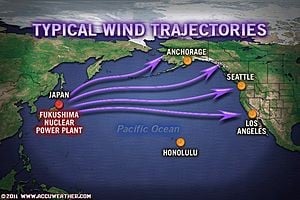
fukushima-radiation-wind-trajectories
Does anyone in authority anywhere tell the truth about Fukushima? 
 If there is any government or non-government authority in the world that is addressing the disaster at Fukushima openly, directly, honestly, and effectively, it’s not apparent to the outside observer what entity that might be.
There is instead an apparent global conspiracy of authorities of all sorts to deny to the public reliably accurate, comprehensible, independently verifiable (where possible), and comprehensive information about not only the condition of the Fukushima power plant itself and its surrounding communities, but about the unceasing, uncontrolled release of radioactive debris into the air and water, creating a constantly increasing risk of growing harm to the global community. 
While the risk may still be miniscule in most places, the range of risk rises to lethal in Fukushima itself. With the radioactive waste of four nuclear reactors (three of them in meltdown) under uncertain control for almost three years now, the risk of lethal exposure is very real for plant workers, and may decrease with distance from the plant, but may be calculable for anyone on the planet. No one seems to know. No one seems to have done the calculation. No one with access to the necessary information (assuming it exists) seems to want to do the calculation.
 There is no moral excuse for this international collusion. The excuses are political or economic or social, but none of them excuses any authority for withholding or lying about information that has potentially universal and destructive impact on everyone alive today and everyone to be born for some unknown generations. 
 Japanese authorities may be the worst current offenders against the truth, as well as the health and safety of their people. Now the Japanese government has passed a harsh state secrets law that threatens to reduce or eliminate reliable information about Fukushima. The U.S. government officially applauded this heightened secrecy, while continuing its own tight control on nuclear information. Japanese authorities are already attacking their own people in defense of nuclear power: not only under-measuring and ignoring varieties of radioactive threat, but even withholding the iodine pills in 2011 that might have mitigated the growing epidemic of thyroid issues today. Failing to confront Fukushima honestly, the Japanese are laying the basis for what could amount to a radiological sneak attack on the rest of the world.
Just because no one seems to know what to do about Fukushima is no excuse to go on lying about and/or denying the dimensions of reality, whatever they might be.
There are hundreds, probably thousands of people with little or no authority who have long struggled to create a realistic, rational perspective on nuclear threats.  The fundamental barrier to knowing the scale of the Fukushima disaster is just that: the scale of the Fukushima disaster.
Chernobyl 1986 and Fukushima 2011 are not really comparable
Chernobyl is the closest precedent to Fukushima, and it’s not very close. Chernobyl at the time of the 1986 electric failure and explosion had four operating reactors and two more under construction. The Chernobyl accident involved one reactor meltdown. Other reactors kept operating for some time after the accident. The rector meltdown was eventually entombed, containing the meltdown and reducing the risk. Until Fukushima, Chernobyl was considered the worst nuclear power accident in history, and it is still far from over (albeit largely contained for the time being). The Chernobyl Exclusion Zone of roughly 1,000 square miles remains one of the most radioactive areas in the world and the clean-up is not even expected to be complete before 2065. 
 At the time of the March 11, 2011, earthquake and tsunami, the Fukushima plant had six operating reactors. Three of them went into meltdown and a fourth was left with a heavily laden fuel pool teetering a hundred feet above the ground. Two other reactors were undamaged and have been shut       down. Radiation levels remain lethal in each of the melted-down reactors, where the meltdowns appear to be held in check by water that is pumped into the reactors to keep them cool. In the process, the water gets irradiated and that which is not collected on site in leaking tanks flows steadily into the Pacific Ocean. Within the first two weeks, Fukushima radiation was comparable to Chernobyl’s and while the levels have gone down, they remain elevated.
 The plant’s corporate owner, Tokyo Electric Power Company (TEPCO), in turn effectively owned by the Japanese government after a2012 nationalization, began removing more than 1,500 fuel rod assemblies from the teetering fuel pool in November, a delicate process expected to take a year or more. There are additional fuel pools attached to each of the melted down reactors and a much larger general fuel pool, all of which contain nuclear fuel rod assemblies that are secure only as long as TEPCO continues to cool them. The Fukushima Exclusion Zone, a 12-mile radius around the nuclear plant, is about 500 square miles (much of it ocean); little specific information about the exclusion zone is easily available, but media coverage in the form of disaster tourism is plentiful, including a Google Street View interactive display.   
 Despite their significant differences as disasters, Chernobyl and Fukushima are both rated at 7 – a “major accident” on the International Nuclear Event Scale designed in 1990 by the International Atomic Energy Agency (IAEA). That is the highest rating on the scale, a reflection of the inherent denial that colors most official nuclear thinking. Designed by nuclear “experts” after Chernobyl, the scale can’t imagine a worse accident than Chernobyl which, for all its intensity, was effectively over as an accident in a relatively short period of time. At Fukushima, by contrast, the initial set of events was less acute than Chernobyl, but almost three years later they continue without any resolution likely soon. Additionally Fukushima has three reactor meltdowns and thousands of precarious fuel rod assemblies in uncertain pools, any of which could produce a new crisis that would put Fukushima clearly off the scale. 
 And then there’s groundwater. Groundwater was not a problem at Chernobyl. Groundwater is a huge problem at the Fukushima plant that was built at the seashore, on a former riverbed, over an active aquifer. In a short video, nuclear engineer Arnie Gunderson makes clear why groundwater makes Fukushima so hard to clean up, and why radiation levels there will likely remain dangerous for another hundred years.
Fukushima Unit #3 activity led to some panic-driven reporting in 2013
 The Japanese government and nuclear power industry have a history of not telling the truth about nuclear accidents dating back at least to 1995, as reported by New Scientist and Rachel Maddow, among others. Despite Japan’s history of nuclear dishonesty, Japanese authorities remain in total control of the Fukushima site and most of the information about it, without significant objection from most of the world’s governments, media, and other power brokers, whose reputation for honesty in nuclear matters is almost as bad as Japan’s. In such a context of no context, the public is vulnerable to reports like this from the Turner Radio Network (TRN) on December 28:  
Five days after this story was posted, the “radiation cloud” had not developed despite the story’s assertion that: “Experts say this could be the beginning of a ‘spent fuel pool criticality (meltdown)’ involving up to 89 TONS of nuclear fuel burning up into the atmosphere and heading to North America.” The story named no “experts” and provided links only to TEPCO announcements in Japanese. The bulk of the story reads like an infomercial for “protective” gear of various sorts that TRN makes a point of saying it does NOT sell.  Despite such obvious warning signs, others – such as The Ecologist and Gizmodo – reported the threat of “another meltdown” at Fukushima Unit #3 as imminent. 
Clarification and reassurance quickly started chasing the “new meltdown” rumor around the Internet. ENENEWS (Energy News) promptly posted the TEPCO reports in English, demonstrating that there was nothing “sudden” about the steam releases, they’ve been happening more or less daily since 2011, but condensation caused by cold weather makes them visible. At FAIREWINDS (Energy Education), Arnie Gunderson posted on January 1: 
“… the Internet has been flooded with conjecture claiming that Fukushima Daiichi Unit 3 is ready to explode…. Our research, and discussions with other scientists, confirms that what we are seeing is a phenomenon that has been occurring at the Daiichi site since the March 2011 accident…. While the plants are shutdown in nuke speak, there is no method of achieving cold shut down in any nuclear reactor. While the reactor can stop generating the actual nuclear chain reaction, the atoms left over from the original nuclear chain reaction continue to give off heat that is called the decay of the radioactive rubble (fission products)…. constantly releasing moisture (steam) and radioactive products into the environment.” [emphasis added]   
In other words, Fukushima Unit #3 continues to leak radioactivity into both air and water, as Units #1 and #2 presumably do as well. But as Gunderson explains, the level of radioactivity has declined sharply without becoming benign:
 “When Unit 3 was operating, it was producing more than 2,000 megawatts of heat from the nuclear fission process (chain reaction in the reactor). Immediately after the earthquake and tsunami, it shut down and the chain reaction stopped, but Unit 3 was still producing about 160 megawatts of decay heat. Now, 30 months later, it is still producing slightly less than 1 megawatt (one million watts) of decay heat…. 1 megawatt of decay heat is a lot of heat even today, and it is creating radioactive steam, but it is not a new phenomenon.” 
 Reassurances about Fukushima are as misleading as scare stories
The reassuring aspects of the condition of Unit #3 ­– radioactive releases are not new, they’re less intense than they once were, the nuclear waste is cooling ­– while true enough, provide only a false sense of comfort. Also true: radiation is released almost continuously, the releases are uncontrolled, no one seems to be measuring the releases, no one seems to be tracking the releases, no one is assessing accumulation of the releases. And while it’s true that the waste is cooling and decaying, it’s also true that a loss of coolant could lead to another uncontrolled chain reaction. (“Fukushima Daiichi Unit 3 is not going to explode,” says Gunderson in a headline, but he can’t know that with certainty.)
 For the near future, what all that means, in effect, is that the world has to accept chronic radiation releases from Fukushima as the price for avoiding another catastrophic release. And even then, it’s not a sure thing.
But there’s another aspect of Fukushima Unit #3 that’s even less reassuring. Unit #3 is the one Fukushima reactor that was running on Mixed oxide fuel, or MOX fuel, in its fuel rods. MOX fuel typically uses Plutonium mixed with one or more forms of Uranium. Using Plutonium in fuel rods adds to their toxicity in the event of a meltdown. In part because Plutonium-239 has a half-life of 240,000 years and can be used to make nuclear weapons of “dirty bombs,” its use in commercial reactors remains both limited and controversial. Because it contains Plutonium, MOX fuel is more toxic than other nuclear fuel and will burn at lower temperatures. As Natural Resources News reported in 2011:
 “The mixed oxide fuel rods used in the compromised number three reactor at the Fukushima Daiichi complex contain enough plutonium to threaten public health with the possibility of inhalation of airborne plutonium particles…. Plutonium is at its most dangerous when it is inhaled and gets into the lungs. The effect on the human body is to vastly increase the chance of developing fatal cancers.”
Reportedly, TEPCO plans don’t call for the removal of the MOX fuel in Unit #3 for another decade or more. Fuel removal from Units #1, #2, and #3 is complicated by lethal radiation levels at all three reactors, as well as TEPCO’s inability so far to locate the three melted cores with any precision.
There is ample reason to hope that Fukushima, despite the complex of uncontrollable and deteriorating factors, will not get worse, because even the Japanese don’t want that. But there is little reason to expect anything but  worsening conditions, slowly or suddenly, for years and years to come. And there is even less reason to expect anyone in authority anywhere to be more than minimally and belatedly truthful about an industry they continue to protect, no matter how many people it damages or kills. 
The perfect paradigm of that ruthlessly cynical nuclear mentality is the current Japanese practice of recruiting homeless people to work at Fukushima in high level radiation areas where someone with something to lose might not be willing to go for minimum wage.

Tuesday, March 11, 2014

"Opt-Out" of the Penopticon!

------------------------------------------------------------------------------------------------------------------------
"Opt-Out" of the Penopticon!
-------------------------------------------------------------------------------------------------------------------------
EDITORIAL     3-11-2014
-------------------------------------------------------------------------------------------------------------------------
Its time for all upright, decent, good-hearted people to learn to "opt-out"
 of the Penopticon.
Its time we get OFF their Internet and learn to throw their smart phones away,
since this whole communications revolution has turned into one big giant spy and
surveillance bonanza for the global military-industrial-intelligence-security corporate
complex.
Lets BOYCOTT these privacy-violating intrusions into our lives and deny them the
"intel" they psychotically, desperately and lustfully thrive after.
If there's no one using their electromagnetic surveillance system, then the
whole thing ceases to operate.
If you haven't already, learn to "opt-out" of the TSA radiation scanners at the airports.
US citizens have a constitutional right to be free of unreasonable searches and
seizures.   Its called the 4th Amendment.  Better yet, learn NOT to fly.  http://wewontfly.com
Without internet, biometric scans, surveillance feeds and smart phone inputs to
the NSA, their whole ILLEGAL surveillance and prison-police state human control system
comes crashing down to the ground.   Learn to "opt-out" of the Penopticon.

Sheri Rodgers
Silicon Valley
Mountain View, California U.S.A.
---------------------------------------------------------------------------------------------------------------------------------
***Addenum:  Here in Silicon Valley, California, one can feel the spirit of evil emanating
from the companies and corporations here that are building the new biometric "mark of the beast"
global electronic spy and surveillance control grid that will enslave humanity.
California, rather than becoming a world leader in cutting edge, innovative environmental technologies
designed to transition our world into a sustainable world civilization (and save our planet) , has instead become a
world leader  in enslaving and degrading the human species.
A state that builds one college for every 22 state prisons is a state that has
definitely got its priorities backwards.   Thanks to the state of California, we will have nothing
to pass on to our future generations, except a world devoid of truth, dignity and human freedom.
-----------------------------------------------------------------------------------------------------------------------------------

Saturday, March 1, 2014

PLANET X IN BIBLE PROPHECY

-------------------------------------------------------------------------------------------------------------
PLANET X IN BIBLE PROPHECY
--------------------------------------------------------------------------------------------------------------
Commentary/ March 4, 2014
--------------------------------------------------------------------------------------------------------------

"And there shall be signs in the sun, and in the moon, and in the stars; and upon the earth distress of nations,
with perplexity; the sea and the waves roaring;
Men's hearts failing them for fear, and for looking after those things which are coming on the earth:
for the powers of heaven shall be shaken."

- Luke 21:25-27

--------------------------------------------------------------------------------------------------------------
There is an event coming to the Earth that will shake this planet and its inhabitants to the very core: 

Its called Planet X.
We live in a binary star system.  In fact, 60-90% of all stars in our galaxy are binary stars.  Our binary

star, in astronomical terms, is known as a "brown dwarf".   That is, a star that didn't have enough nuclear
mass to ignite into a shining star during its birth.  Its a heavy object with a mass 5-10 times greater

than that of the Earth.   It is this "star" that has been dubbed, "Planet X", the tenth planet.
This star/planet has a highly elliptical 3,600 year orbit below the southern ecliptic, as well as its

own mini solar system.  It can only be seen in the infrared since it doesn't shine like most stars.
It has a dark red color to it due to the fact that it is predominantly made up of nickel and iron oxide.

Planet X was first discovered back in December of 1982 and has been debunked and kept highly
classified within the world's major scientific, space and security institutions and agencies since then.

Many have speculated that this 10th planet is soon scheduled to make another flyby.  Some predict
as early as 2016.   If and when another flyby occurs, historical evidence suggests that there will be

large earthquakes, numerous volcanic eruptions, the shifting of tectonic plates leading to the sinking and
upheaval of large segments of the earth's crust, and massive tidal waves inundating most coastal

and inland continental areas of our planet.
We may see large plasma and red iron oxide discharges between Planet X and the Earth due to the

large gravitational force that will synchronize between these 2 bodies once this flyby occurs again.
Historical evidence also suggests that during this time, our planet may go through another pole shift,

or experience another magnetic polar reversal, which will cause great destruction, damage and
distress upon our world and its inhabitants.

In the past this has resulted in the sun remaining stationary in the sky for 3 or more days.  And, as
the north and south poles shift and re-establish themselves onto adjacent sectors of the Earth's

surface, there will be flash freezes over entire regions of the Earth, as well as a complete reversal
of the sun's path across our sky.

There is speculation in Bible prophecy eschatology that Planet X may be the reference to "Wormwood"
in the Book of Revelations.   If this is true, then it won't be a global thermonuclear war

that is prophesized to take out 1/3rd of Mankind at the end of days (as many believe), but the destruction
wrought by a large incoming comet brought in by Planet X as it makes its next transit through our solar

system.
Finally, it must be noted that during Planet X's last flyby, we had the seas parting and the waters turn

blood red as recorded in the Book of Exodus, and before that, the Great Flood during Noah's time.
The fulfillment of Biblical prophecy seems to line up perfectly with celestial events such as with the annual

flyby of Planet X.   It might be a good idea to keep close tabs on the specifics and timing of its next
flyby, since it may in fact, be a confirmation that we are ready to enter into the Last Days

of biblical prophecy as revealed and recorded in the Christian New Testament.
For more information and to learn more about Planet X, go to my website:  http://burntsnow7.tripod.com


Steve Jones
Prophecy researcher

Flagstaff, Arizona
USA